1. Introduction
Stenciling in microcement is considered one of the most advanced and sensitive techniques in the execution of decorative surfaces. In this method, the goal is not merely to create a pattern, but to achieve precise edges, a uniform surface, and long-term durability. Contrary to common belief, success in stenciling depends less on the installer’s skill and more on selecting the right type of microcement. The material used must exhibit fully controllable behavior and show minimal negative reaction to execution errors.
2. What Is Microcement Stenciling?
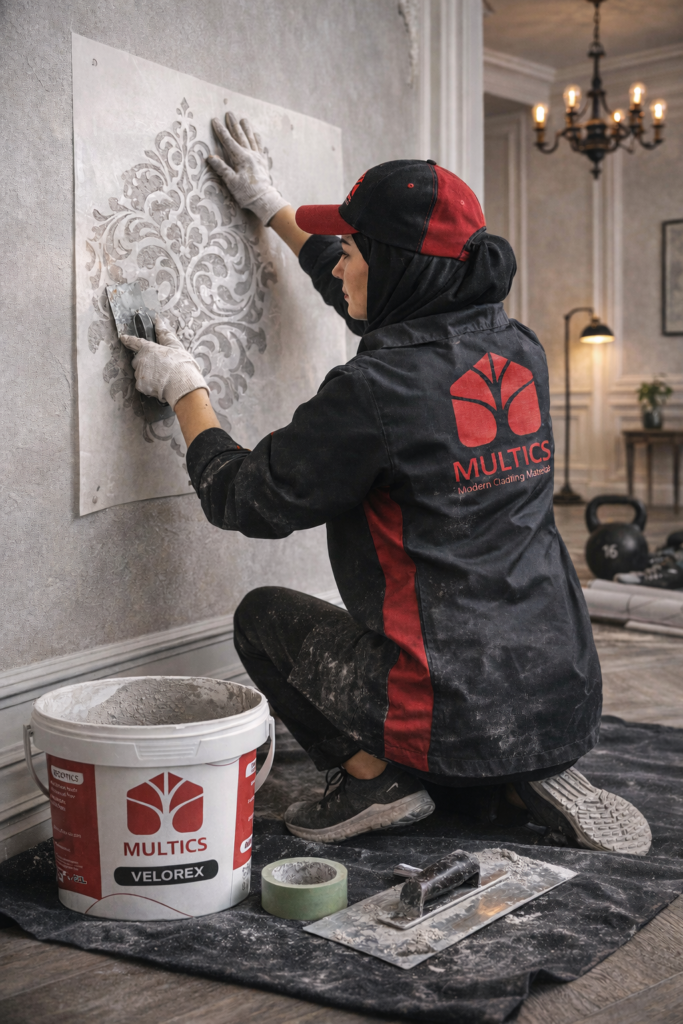
Stenciling is a process in which a desired pattern is applied to the final layer of microcement using ready-made or custom stencils. These patterns may include geometric designs, traditional motifs, logos, or even graphic lettering. In this technique, a thin layer of microcement is spread over the stencil, and once it is removed, the pattern remains either raised or flush with the background. Due to the very thin application layer, the quality of the mortar plays a decisive role in the final result.
3. Why Is the Choice of Microcement Important in Stenciling?
Not all microcements are designed for stenciling. Many products available on the market are manufactured for flooring or industrial surfaces, focusing primarily on mechanical resistance rather than execution finesse. These microcements typically have coarser aggregates, which create uneven edges when applied along stencil boundaries. In addition, some mortars are either too fluid and seep under the stencil, or they set too quickly, leaving no time for corrections. For this reason, selecting the appropriate microcement is critical in this technique.
4. The Role of Grain Size in Stenciling Quality
One of the most important characteristics of stencil-suitable microcement is an extremely fine and uniform grain size. The smaller the particle size, the better the mortar spreads beneath the stencil, resulting in clean and sharp edges after removal. Fine microcements designed for finishing layers are the best option in this regard. Using coarse-grained products often leads to edge breakage and loss of design precision.
5. The Importance of Polymer Structure in Stencil Microcement
The polymer structure of microcement plays a key role in adhesion and flexibility. Polymer-modified microcements adhere firmly to the substrate during stencil removal, preventing the pattern from detaching. This feature is especially important for delicate designs and thin lines. Additionally, polymers reduce internal stresses and help prevent cracking in thin stencil-applied layers.
6. Proper Viscosity for Stencil Application
The viscosity of microcement is a determining factor in successful stenciling. A mixture that is too fluid lacks control and penetrates beneath the stencil. Conversely, a mixture that is too stiff does not spread evenly and may pull parts of the design away when the stencil is removed. Suitable stencil microcement should have a stable, paste-like consistency—responsive to the trowel’s pressure without flowing freely.
7. Working Time and Its Effect on the Final Result
Working time is highly important in microcement stenciling. If the setting time is too fast, accurate execution and fine adjustments become impossible. On the other hand, excessively slow setting can cause deformation of the pattern when the stencil is removed. Microcement designed for stenciling must offer balanced workability, allowing the installer to execute the design with confidence.
8. Can Regular Microcement Be Used for Stenciling?
In some projects, installers attempt to adapt standard microcements for stenciling by adjusting water ratios, increasing polymer resin content, or sieving the powder. While these methods may work in limited cases, their results are not always predictable. In professional decorative projects, using microcement specifically designed for stenciling significantly reduces execution risks.
9. Final Summary
In conclusion, the best type of microcement for stenciling is a fine, polymer-modified microcement with controlled viscosity. This material enables precise designs, clean edges, and a uniform surface, making it an ideal choice for high-end decorative projects.
At MULTICS, microcement formulations are developed based on real execution requirements and mortar behavior in on-site conditions. As a result, MULTICS decorative products for applications such as stenciling are engineered with a targeted and performance-driven approach.